October 30, 2026
Why Unlimited Digital Signatures Matter for Modern Remote Signing
By @unlimiteddigitalsignaturesdesk
The Hidden Bottleneck in Remote Signing
When I first started working with PKI-based signing workflows, the biggest frustration was always the same: limits. Not limits on what you could sign, but limits on how many times you could sign before the system got in your way. Every platform seemed to have a cap on the number of signatures per user per month, or per certificate, or per device. It felt like being told you could only send twenty emails a day. In a world where contracts, approvals, and code releases happen around the clock, that kind of restriction doesn't just annoy people; it slows down business.
Over the years, I've watched organizations struggle with this. A legal team at a mid-size firm needed to execute hundreds of PDF signing tasks in a single quarter, but their eSignature platform capped them at fifty per user. They ended up juggling multiple accounts, sharing credentials, and eventually just paying for more licenses than they needed. That's not a signing problem; that's a workflow design problem. The real solution is having unlimited digital signatures as a baseline capability, not a premium add-on.
What Unlimited Digital Signatures Actually Means
Let's be precise. When I say unlimited digital signatures, I don't mean signing without security checks or identity verification. I mean a system where the number of signatures you can produce is not artificially constrained by a licensing model or a per-certificate count. The limit should be your private key's lifespan, your compliance requirements, and nothing else. If you hold a valid digital certificate from a trusted authority like DigiCert, GlobalSign, or Sectigo, you should be able to sign documents and code as many times as your workflow demands, without hitting a paywall every month.
This is especially important for teams that handle high-volume signing. Consider a software development shop that signs every release with a code signing certificate. If that certificate is stored on a USB token or a hardware security module, the team should be able to sign builds, patches, and updates continuously. A limit on the number of signatures per month would force them to either batch releases or risk running out of signing capacity mid-cycle. Neither is acceptable in a competitive market.
The same logic applies to PDF signing for contracts, NDAs, and compliance documents. If your legal or sales team uses Adobe Sign or DocuSign, those platforms often have subscription tiers tied to signature volume. But the underlying PKI infrastructure does not impose such limits. A properly configured remote signing solution should decouple the signing capacity from the subscription plan, giving you unlimited digital signatures as a technical reality, not a marketing promise.
How Hardware Security Makes Unlimited Signing Possible
The key to this is keeping the private key secure while making it accessible for signing operations. Traditional USB tokens like YubiKey or OneSpan devices hold the private key on the hardware itself. That's excellent for security; the key never leaves the token. But it creates a physical limitation: you need the token plugged into the machine that performs the signing. For remote signing, that's a non-starter.
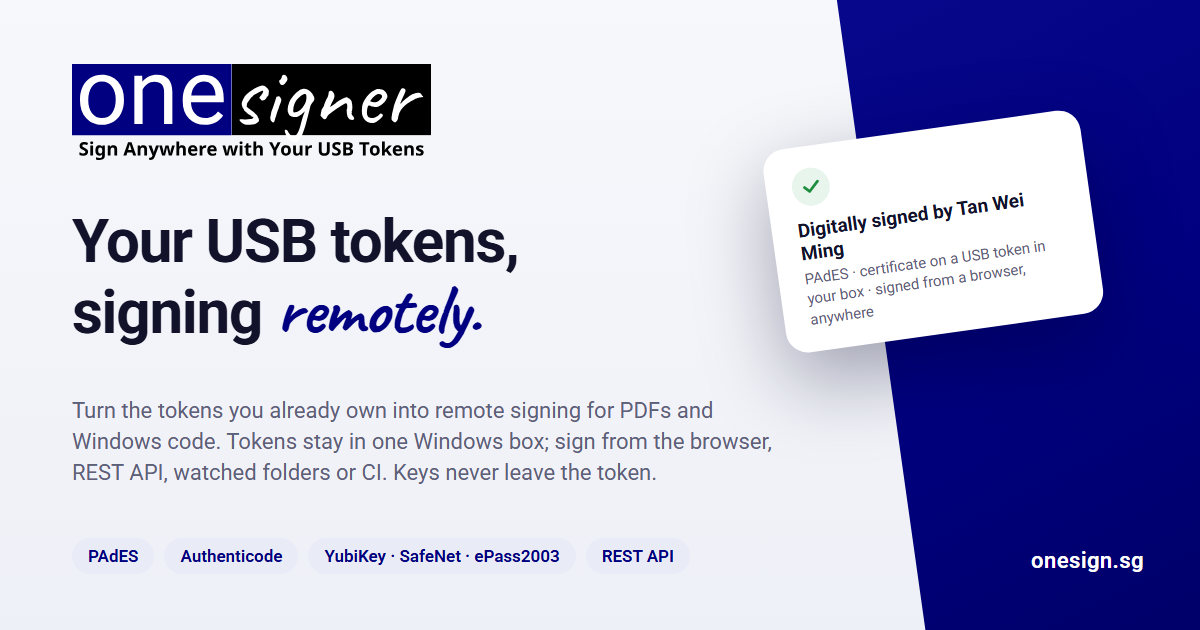
Modern approaches solve this by using remote signing servers that communicate with the hardware token over a secure channel. The private key stays on the USB token, which is connected to a central server or a hardware security module in a data center. The signing request travels to the token, the signature is generated on the hardware, and the result comes back. The user never has to touch the token physically, and the token can handle an unlimited number of signing operations as long as it's powered and connected.
This design removes the bottleneck. Your team can sign from anywhere, using their existing USB tokens, without moving private keys from the hardware. The signing workflow becomes a matter of authenticating to the remote signing server, not of physically accessing the token. And because the hardware does the cryptographic work, you get unlimited digital signatures without compromising the security model that PKI relies on.
Real-World Examples of High-Volume Signing
I once consulted for a fintech company that needed to sign thousands of PDF agreements per day. Their old process used local USB tokens passed around the office. It was slow, error-prone, and a security nightmare. They migrated to a remote signing setup where each employee's YubiKey stayed at their desk, plugged into a shared server. The signing server handled authentication and routing. Suddenly, they could process the same volume with half the staff time, and the number of signatures was limited only by the server's throughput, not by any per-user cap.
Another example: a software vendor that signs executables and firmware updates for IoT devices. They use code signing certificates from Sectigo stored on hardware security modules. Their CI/CD pipeline signs every build automatically. With a traditional setup, they would have hit signing limits every few weeks. With a remote signing architecture that allows unlimited digital signatures, they sign hundreds of builds daily without any manual intervention or extra cost. The only constraint is the certificate's validity period, not a monthly quota.
These are not edge cases. Any organization that relies on digital certificates for identity verification and document integrity will eventually hit a ceiling if their signing platform enforces volume limits. The cost of those limits is not just financial; it's operational. Teams start hoarding signatures, delaying approvals, or working around the system. None of that is good for compliance or efficiency.
The Role of Standards and Compliance
Unlimited digital signatures also matter from a regulatory standpoint. Under GDPR and other data protection frameworks, you need to demonstrate that your signing process is secure and auditable. If your platform limits the number of signatures you can produce, you might be forced to use multiple certificates or accounts, which complicates auditing. A single, unlimited signing capability on a single certificate is easier to track, revoke, and renew. It's cleaner for compliance.
Similarly, for eSignatures under eIDAS or ESIGN, the legal validity of a signature does not depend on how many signatures you've already made. It depends on the integrity of the private key, the certificate chain, and the identity proofing at issuance. A certificate from DigiCert or GlobalSign is valid for a fixed period and can sign an unlimited number of documents within that period. The platform should reflect that. Any artificial limit is a business decision, not a technical requirement.
What to Look for in a Remote Signing Solution
If you're evaluating tools for your team, here are a few things to consider:
- Does the solution support your existing USB tokens or hardware security modules, such as YubiKey or OneSpan devices?
- Can you configure the remote signing server to allow unlimited signing operations per certificate, without per-signature fees?
- Is the integration with your signing workflow, whether it's for PDF signing or code signing, straightforward? Does it work with tools like OpenSSL or Adobe Sign?
- How does the platform handle identity verification when the token is not physically present? Is there a secure authentication step?
- Does the solution log every signing event for audit purposes, and can it scale to thousands of signatures per day?
These questions will help you separate platforms that truly offer unlimited digital signatures from those that just claim it in marketing materials. The technical architecture matters more than the price per signature. If the private key never leaves the hardware, and the signing server can handle an arbitrary number of requests, you're on the right track.
Final Thoughts
The push toward remote signing is not going to slow down. Teams are distributed, deadlines are tight, and security expectations keep rising. The old model of plugging a USB token into a local machine and hoping the certificate doesn't expire mid-project is obsolete. What works now is a system that gives you unlimited digital signatures, keeps your private key safe in hardware, and lets your team sign from anywhere.
I've seen organizations waste months negotiating signature limits with vendors, only to realize they could architect their way out of the problem. The technology exists. PKI is not the bottleneck; the business models that wrap it are. If you're serious about signing efficiency, look for a solution that treats unlimited digital signatures as the default, not a premium tier. Your signing workflow will thank you.
❧